Skip to main content

Why short poses and a dozen quick charcoal drawings a session will teach you faster than one careful drawing ever could.
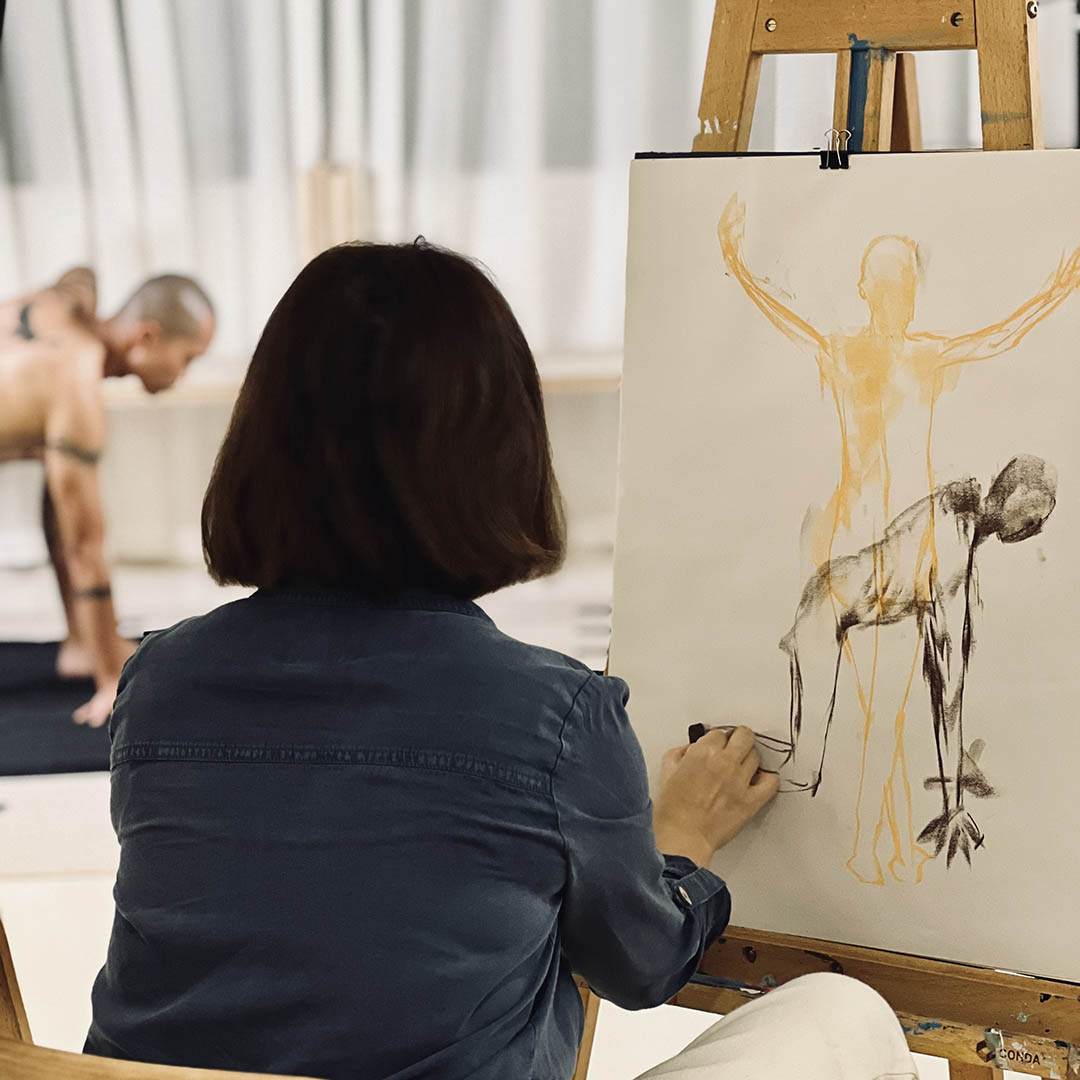
The fastest way to get better at drawing is to do a lot of drawings in a short space of time. That sounds obvious, but most people sit down with one sheet of paper and try to make it count. When the whole aim is one careful drawing, every mark carries too much weight. You second-guess, you erase, you slow down. And slow is the one thing a short pose will not let you be.
At our life drawing sessions at New Bahru, a single evening of short poses will produce somewhere between 12 and 16 drawings. Charcoal on newsprint, pose after pose, and when the timer goes you start again. You make your marks, the pose ends, and you move on.
When you spend an hour on one drawing, you have one attempt to understand proportion, weight and gesture. If it goes wrong, you've learned something, but slowly and painfully. When you spend five minutes on a drawing and then do eleven more, you get twelve attempts at the same set of problems. Each one informs the next. Mistakes stop feeling costly because there's always another sheet of paper.
When you only have two minutes, you have to decide immediately what matters. Is it the weight in the hips? The angle of the shoulder? The bend at the knee? You cannot draw everything, so you choose. And choosing, even badly, is how you start to understand what you are actually looking at.
One student described it as an art HIIT session: short, intense bursts of drawing with brief recovery periods. That's a pretty good description. You're working hard inside each pose, then you step back, look at what happened, and go again.
We ask everyone to draw big. Beginners almost always start too small, tucking a figure into the corner of the page as though they're trying not to take up too much room. A small drawing lets you be vague. A figure that fills the page demands decisions: where exactly is that shoulder, how far does that arm reach, what's happening at the hip.
Filling the newsprint is as much a part of the practice as the pose itself. It's not about being bold for its own sake. A large drawing simply shows you what you don't know yet, and that's useful information.
Improvement within one session is common enough that we've stopped being surprised by it. The first drawing of the night is usually stiff, a bit cautious. By the final few poses, something has loosened. The proportions start behaving. I have seen someone's line quality change visibly between their first drawing of an evening and their last. Twelve attempts in two hours will do that. One careful drawing spread across the same two hours will not.
This is what failing faster gets you. You are not grinding through weeks of careful study waiting for a breakthrough. The feedback loop is compressed into a single evening of life drawing in Singapore, and you can see the arc of your own progress laid out across a stack of newsprint sheets at the end of the night.
It's worth saying: this is not about accuracy as the goal. A gesture drawing at the end of a short pose isn't meant to be a forensic record of a body. The point is understanding how to read a figure quickly and commit to what you see. That's a different skill from copying carefully, and in some ways a harder one.
Life drawing has a reputation for being an advanced activity, something you do after years of study. I don't think that holds up. Yes, experience helps. But the short-pose format is particularly good for people who are earlier in their practice, because it removes the pressure of the single precious drawing. You can't be precious when the timer is running.
If you've been drawing for a while and feel like you've plateaued, the volume of attempts in a life drawing session tends to shake things loose. If you're newer to drawing and want to build confidence quickly, the same applies. And if you would rather build the fundamentals in a guided setting first, our adult art classes cover drawing from the ground up. It also pairs naturally with urban sketching, another way of practising quick drawing from life.
Our life drawing sessions at New Bahru run regularly, and you don't need prior experience to join. You'll need charcoal and newsprint, which we'll sort out, and a willingness to fill the page.
Our life drawing sessions run regularly at the New Bahru studio, with short and long poses and a mix of session formats through the year. Charcoal and newsprint are provided, and artists of all levels share the same room and the same timer. Have a look at how the sessions work.
Life drawing is drawing the human figure from a live model, in timed poses. Sessions usually move from short poses of one to five minutes into longer ones, and you work by observation rather than from photographs. At our sessions you'll draw in charcoal on newsprint, which keeps things fast and unprecious.
Nearly. Figure drawing means drawing the human figure from any reference, including photos or casts. Life drawing is figure drawing from a live model in the room. In Singapore the two terms are often used interchangeably, and the skills carry over directly.
We run both. Some sessions work from a nude model in the classical tradition, others from a clothed model, and we sometimes run themed sessions too. If you have a preference, check the details of the session you're joining.
No. The short-pose format suits beginners particularly well because no single drawing carries much weight. Materials are provided, and the only real instruction to start with is to draw big and keep going.