Skip to main content

Practical, studio-tested art appreciation activities for children, the best ways to teach looking, discussing and responding, from our art studio in Singapore.
Art appreciation isn't about teaching children to say the right things in front of a painting. It's about slowing down, looking carefully, and finding something personal in what they see. Done well, it sharpens observation skills, builds visual vocabulary, and makes children far more confident in their own creative decisions. Here are the art appreciation activities for children that I've seen work consistently, both in our classes at Chalk N Pencils and at home.
The most common mistake is narrating an artwork before a child has had a chance to look at it properly. Instead, give them thirty seconds of silence first. Then ask: what's the first thing you noticed? What do you think is happening? Does anything feel uncomfortable or strange?
These open questions do something important. They position the child as the expert on their own perception. There's no wrong answer. Once they've shared what they see, you can layer in context: who made it, when, why. That sequence matters. Context should follow observation, not replace it.
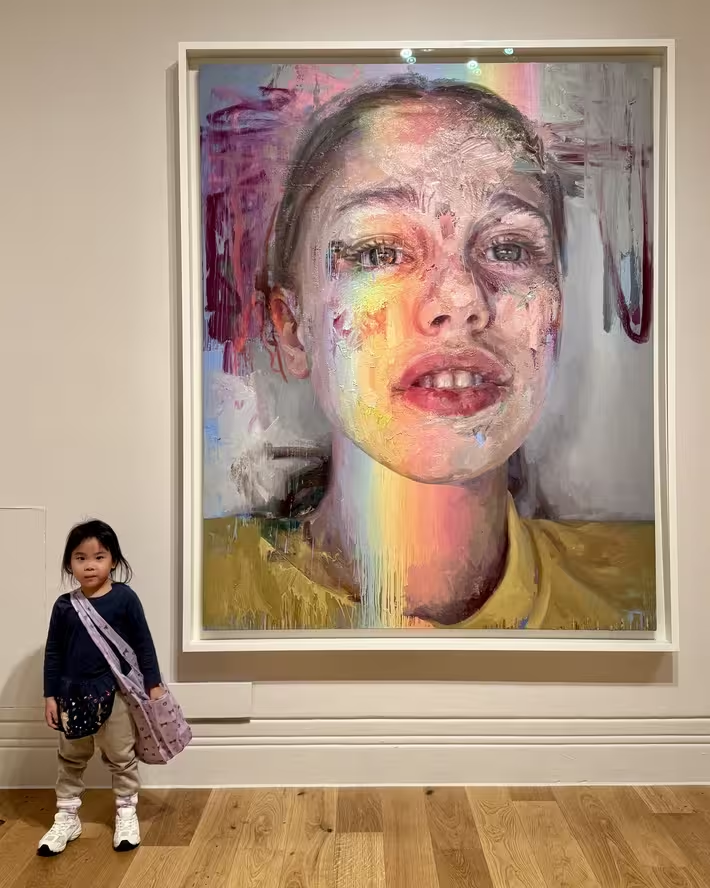
This is also, in my experience, one of the best ways to teach art appreciation at any age: observation first, information second. Printouts of paintings, museum visits, or simply pulling up images on a screen all work. Velazquez, Hopper and Yayoi Kusama are all surprisingly engaging for young children for different reasons, the first for storytelling, the second for mood, the third for pattern. The child pictured above spent a long while with Jenny Saville's monumental portraits at her exhibition at the National Portrait Gallery, walking the room, talking through the works and settling on a favourite. Bold, unfamiliar work can hold a child completely, if you simply let them look.
Looking and discussing is only half of it. The more lasting learning happens when children respond to a work of art by making something of their own. This doesn't mean copying, it means responding. Ask them to paint the feeling of a piece rather than the image. Or take one element, colour palette, composition, texture, and apply it to a completely different subject.
In our children's art classes, we often introduce a masterwork at the start of a lesson not as a model to replicate, but as a provocation. A child who has spent time with Rothko's colour fields will approach their own colour mixing differently. A child who has studied Hokusai's waves will think more carefully about rhythm and line.
This is one of the reasons art appreciation activities for children work better in a structured class setting, there's immediate opportunity to apply what they've absorbed.
You don't need to visit a gallery every weekend. A few small habits make a real difference:
The real payoff of art appreciation activities for children comes when it feeds back into their own work. A child who has looked carefully at a range of artists starts to develop taste, and from taste, a more considered personal style begins to emerge.
This connection is something we take seriously at both our Katong Point and New Bahru studios. Our older students in particular engage with art history and contemporary practice as part of their regular curriculum, not as a separate academic exercise. For those working toward portfolios or arts school entry, this kind of critical visual awareness becomes genuinely important.
Our children's art classes at both Singapore locations incorporate art appreciation as a natural part of the learning, not bolted on, but woven through. Classes start from age three, and the approach scales as children grow older and their thinking becomes more sophisticated. For more on how children's art grows over time, see our guide to the stages of artistic development.
The goal, ultimately, is a child who walks into any room and notices what's on the walls, and has something to say about it.
Our children's art classes weave looking, discussing and making together at Katong Point and New Bahru. Take a look at how the classes run.
Start with looking before explaining. Give a child time to observe, ask open questions about what they notice, and only then add context. Follow it with a hands-on response, making something in reply to the work, so the looking turns into doing.
From around age three. Very young children respond well to colour, pattern and story; the discussion simply grows more sophisticated as they get older.
We weave art appreciation through every one of our children's art classes at our Katong Point and New Bahru studios rather than teaching it as a separate course, so children apply what they notice straight away in their own work.
Making art is producing; appreciation is perceiving. The two reinforce each other, a child who looks carefully at others' work makes more considered choices in their own.